
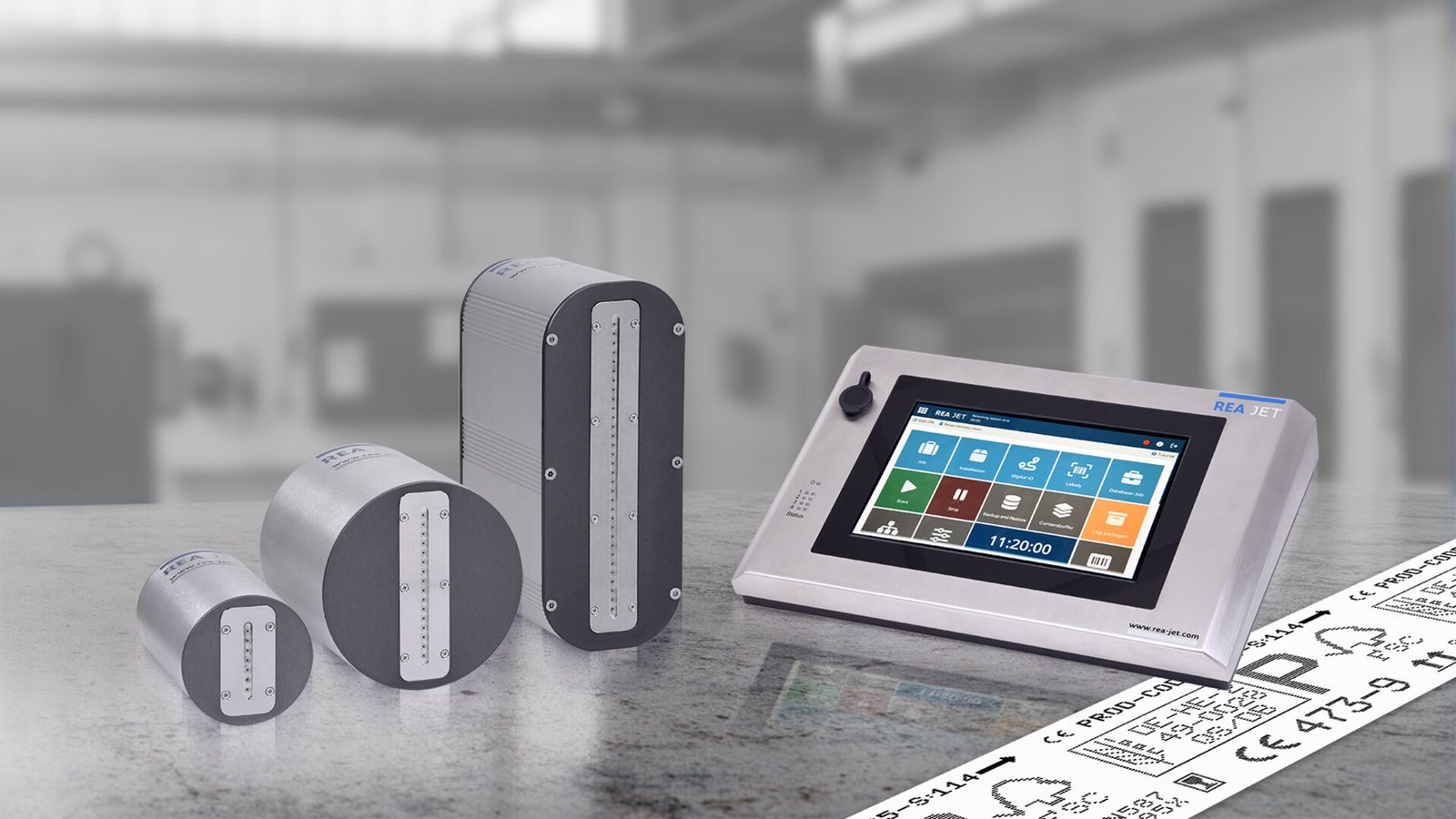
When evaluating an industrial inkjet printer, the temptation is to start by comparing brands or data sheets. The reverse order avoids unpleasant surprises: first choose the technology that suits your product, your throughput and your substrate, and only then the model.
Here is a guide to tell apart the three main families of inkjet coders used in industrial marking: continuous inkjet, thermal inkjet and large-character. The examples draw on the REA Jet range, which we distribute.
Why technology comes before brand
Successful marking results from a chain of decisions: the substrate (cardboard, plastic, metal, glass), the size and nature of the information to print (date and lot, 2D code, logo, large lettering), the line speed and the environment (dust, moisture, washdown). Each technology handles some of these constraints well and others less well.
Choosing the brand first is like choosing a vehicle before knowing whether you need to carry a suitcase or a pallet. Start instead by defining the what and the on what.
Five questions to decide
Before comparing models, answer these questions. They are often enough to rule out one or two technologies.
- What is the substrate? Porous (cardboard, wood, paper) or non-porous (plastic, glass, metal, film)? The answer guides both the technology and the ink.
- What information must be printed? A simple date and lot, a 2D code, a logo or lettering visible from a distance do not require the same resolution or character height.
- How fast does the product move? The line speed, and the distance between the head and the product, directly influence the choice.
- What environment will the coder work in? Dust, moisture, washdown, vibration and temperature swings are all robustness factors to check.
- What level of maintenance are you prepared to take on? Some technologies require managing solvents and filters; others rely on replacing a cartridge.
These answers are the starting point for a productive technical discussion, and they keep you from paying for capacity you do not need.
Continuous inkjet: small characters and high throughput
Continuous inkjet (CIJ) projects a constant stream of micro-droplets, directed without contact onto the product. It is the technology of choice for marking small characters and variable data at high speed on primary packaging and parts.
The REA Jet SC 2.0 is the example in the range. According to the manufacturer's data sheet, it prints 1 to 8 lines of text, barcodes, Data Matrix codes and logos, at a print speed of 400 m/min and a flexible application distance of up to 70 mm. Its IP65 stainless steel enclosure suits washdown or dusty environments, and the ink dries in under a second.
Target surfaces: plastic or glass bottles and containers, cans and metal lids, films, cables and profiles. This versatility on non-porous and curved surfaces is one of the main arguments for continuous inkjet.
One point to factor in from the start: continuous inkjet consumes solvent while running. Managing make-up solvent, flush solvent and filters is part of the system. Our article on inks, solvents and consumables explains how to plan for it.
Thermal inkjet: high resolution, 2D codes and logos
Thermal inkjet (TIJ) is built on precision. Based on HP cartridge technology, it produces sharp prints up to 600 dpi, ideal for lot codes, dates, GS1 barcodes, 2D codes and logos. Each ink cartridge includes a new printhead, which explains the operation described as maintenance-free and service-free.
The thermal range has three models:
- the REA Jet HR 1.0, compact and versatile, for a variety of packaging;
- the REA Jet HR 2.0, latest generation, with standard, solvent-based or UV-curable cartridges;
- the REA Jet HR pro OEM, intended for machine builders and integrators.
Print height is 12.7 mm per head and speed can reach 762 m/min for the HR 1.0 and HR 2.0. Typical surfaces are coated cartons, films and sheets, plastics, labels and sleeves.
Large-character: cartons, cases and porous surfaces
Large-character inkjet, or drop-on-demand (DOD), prints large text, data and logos. It is built for secondary packaging: cases, corrugated cartons, bags, wood, construction materials.
Two models stand out:
- the REA Jet DOD 1.0, rugged, designed for demanding industrial environments, with text, data and logos up to 140 mm per printhead;
- the REA Jet DOD 2.0, new generation, compatible with water-based, MEK and ethanol inks, with a centralized interface on the REA TITAN platform.
Absorbent surfaces such as corrugated cardboard, kraft paper, wood and drywall are natural territory for this technology. Non-porous surfaces call for specialized inks: tell us your substrate before deciding.
Comparison table
| Technology | Typical substrates | Resolution and size | Maintenance |
|---|---|---|---|
| Continuous inkjet (SC 2.0) | Plastic, glass, metal, film, cables, profiles | 1 to 8 lines, small characters, 48 px vertical resolution | Solvent management (make-up, flush), filters |
| Thermal inkjet (HR 1.0, HR 2.0, HR pro OEM) | Coated cartons, films, plastics, labels, sleeves | Up to 600 dpi, 12.7 mm per head | Described as maintenance-free: a new head with each cartridge |
| Large-character (DOD 1.0, DOD 2.0) | Corrugated cardboard, kraft, wood, construction materials | Up to 140 mm per head | Circuit inks and filters; extended-life heads |
Which technology for your sector
Food and beverage
Dates, lots and codes on primary packaging: continuous inkjet on containers and thermal on coated cartons, films and sleeves cover most needs. Thermal also offers low-migration inks for food packaging. See our food solutions.
Pharmaceutical and healthcare
The legibility of a lot or a 2D code is non-negotiable. The high resolution of thermal is particularly relevant here, especially for small formats. Also see how to print sharp DataMatrix codes ahead of Sunrise 2027.
Manufacturing and distribution
Parts, profiles and cables suit continuous inkjet; shipping cases and cartons suit large-character. The manufacturing page presents our approaches for this sector, and our EBS page presents another family of industrial marking solutions.
REA Jet models by technology
- Large-character: DOD 1.0, DOD 2.0, EDS;
- Thermal: HR 1.0, HR 2.0, HR pro OEM;
- Continuous inkjet: SC 2.0;
- Piezo: UP, GK 2.0;
- Spray Mark: STC, STF, ST.
Find all the data sheets on our REA Jet page.
Beyond the data sheet
Two models from different technologies can show comparable performance on paper and behave very differently on your line. Character height, application distance, ease of refilling, control interface and level of integration with your PLCs matter as much as maximum speed. The REA TITAN control platform, shared by several models in the range, simplifies operator training, for example, when several technologies coexist in the same plant.
That is why we recommend approaching the choice as a short project: a simple specification, a test on the actual product, then an informed decision.
Conclusion: validate on your product
No table replaces a test on your actual packaging, at your line speed. Describe your substrate, the information to be marked and your environment: we will guide you to the most logical technology, then to the appropriate model.
Our team responds within 2 business hours
Permanent stock in Quebec. Fast local supply.