
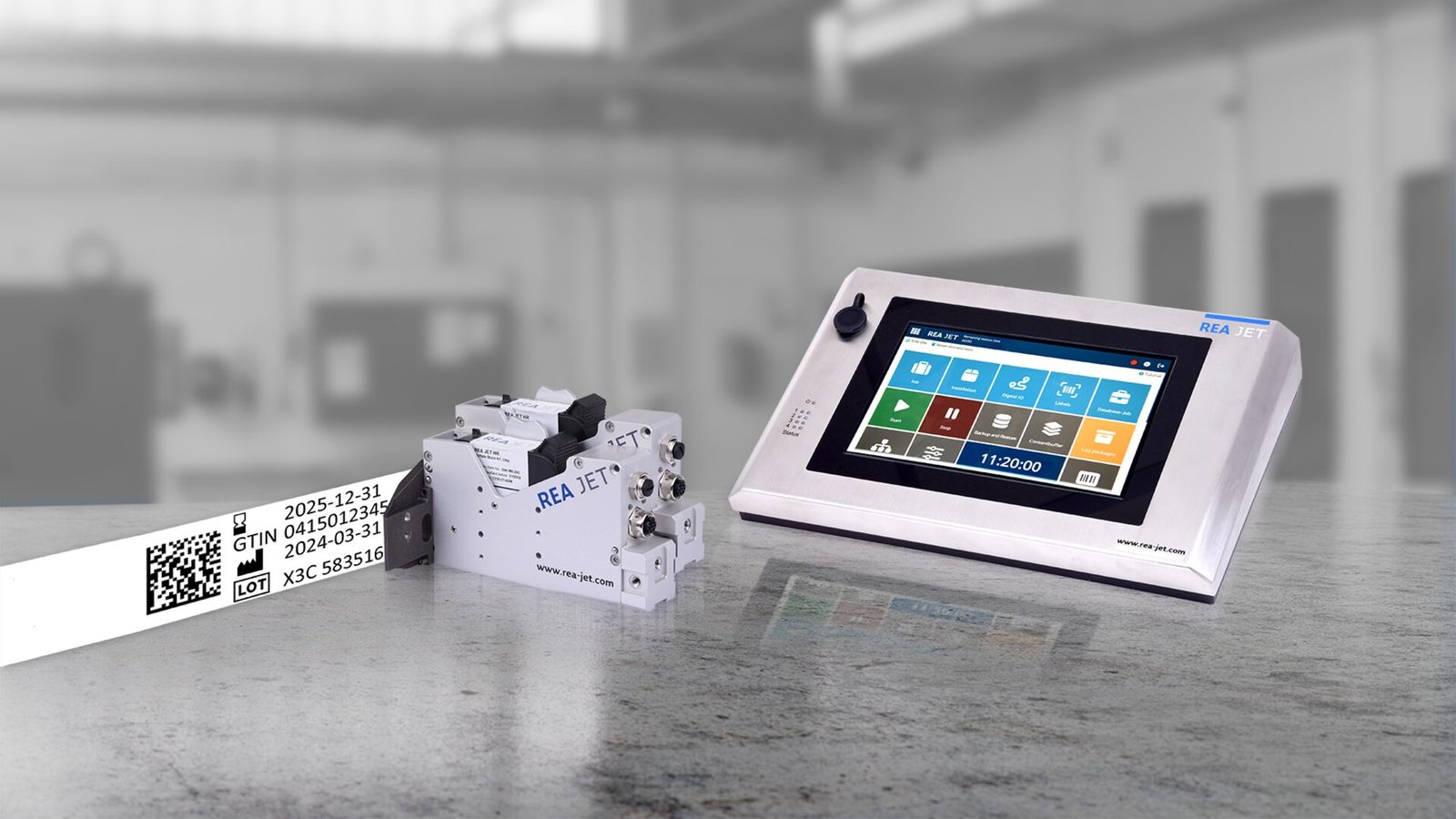
The linear barcode that has appeared on your packaging for decades is no longer the only way to carry product information. With the GS1 Sunrise 2027 initiative, the industry is moving toward 2D codes, in particular the DataMatrix code and its relatives, which can hold far more data in a smaller space. For a plant or a distribution center, the practical question is simple: will my current marking equipment produce these codes sharply, consistently and legibly?
This article explains what the shift to 2D changes, why print quality becomes decisive and how the REA Jet HR 2.0 high-resolution thermal inkjet meets that need. We also propose a five-step transition plan, to be adapted to your situation.
What changes with Sunrise 2027
From linear code to 2D code
A traditional linear code encodes one identifier, typically the GTIN. A 2D code can carry several pieces of information in a single symbol: the product identifier, the lot number, the expiry or packaging date, and sometimes a serial number. This is one of the appeals of the GS1 standard applied to 2D codes: one scan, several reliable data points.
Richer content, therefore higher requirements
The more information a code contains, the finer and tighter its modules (the small squares that make it up). A slight smear, a misplaced drop or low contrast is then enough to make the symbol unreadable. In other words, the transition to 2D shifts attention from the content of the code to the physical quality of its print.
The specific terms of the initiative vary by sector and by trading partner. We suggest validating the requirements that apply to your product category with GS1 Canada and with your retail or distribution customers, then translating them into marking criteria.
Why DataMatrix demands quality printing
A DataMatrix code is read thanks to three ingredients that depend directly on printing:
- Resolution: the higher it is, the better defined the modules are, even on a small symbol.
- Contrast: a well-chosen ink, applied to a suitable substrate, provides the tonal difference the reader needs.
- Module consistency: uniform dots, with no spreading or gaps, ensure consistent decoding at line speed.
None of these is a matter of chance. They result from the printing technology, the ink, the condition of the substrate and the stability of the line integration.
Thermal inkjet for 2D
Thermal inkjet (TIJ) is one of the most natural technologies for printing 2D codes. The REA Jet thermal range, which we distribute, consists of three models:
- the REA Jet HR 1.0, a compact, versatile thermal printer;
- the REA Jet HR 2.0, the latest generation, offered with standard, solvent-based or UV-curable cartridges;
- the REA Jet HR pro OEM, designed for machine builders and integrators.
According to the manufacturer's data sheets, these models print sharp, legible codes up to 600 dpi, with speeds of up to 762 m/min for the HR 1.0 and HR 2.0, and a print height of 12.7 mm per head. The HR pro OEM can mount up to four heads in cascade, for a total height of 50.8 mm, leaving room for a 2D symbol along with its human-readable text.
Another operational advantage: these printers are based on HP thermal cartridge technology, where each ink cartridge includes a new printhead. The design is presented as maintenance-free and service-free, a factor that contributes to marking consistency from one shift to the next.
The HR 2.0 is also described by the manufacturer for lot codes, expiry dates, GS1-compliant barcodes and logos. For serialization and traceability, the HR pro OEM can be controlled directly by the machine's control systems (Ethernet, USB, RS232 or digital inputs/outputs) and handles large volumes of data.
One substrate, one ink, one result
Even the best printhead cannot compensate for a poor ink and substrate combination. On the thermal side, typical surfaces are coated cartons, films and sheets, plastics, labels and sleeves. Inks range from water-based formulations to solvent-based or UV-curable inks (HR 2.0), including fast-drying inks for moving lines and low-migration inks for food packaging.
To understand the options, see our REA Jet inks and supplies page. If you are marking an unusual surface, a test on your own product remains the best way to validate the result.
Verifying legibility: a habit to build
A code that looks sharp to the eye is not necessarily compliant. Legibility verification should be an integral part of your process, and not only at start-up:
- scan a sample with the readers actually used downstream (warehouse, point of sale, customer);
- have code quality assessed with a barcode verifier, using the grading method your partners require;
- record the results whenever ink, substrate, speed or cartridge lot changes;
- plan periodic checks in production rather than a single initial validation.
This discipline also protects your business relationships: an unreadable code means a rejected pallet or a product delayed at receiving.
The sectors most affected
Almost any company that packages consumer products sold at retail is following this development closely. A few contexts where the stakes are particularly high:
- Food: the lot and date on the package support food traceability and targeted recalls. Our food solutions page covers the issues in this sector.
- Pharmaceutical and healthcare: serialization, lots and dates require flawless printing. See our pharmaceutical solutions.
- Distribution and logistics: fast, reliable code reading at receiving and order picking is central to performance. See our distribution page.
Do you mark with another technology, for example a Bestcode system? The logic remains the same: assess the sharpness of 2D codes on your actual substrates before finalizing your plan.
A five-step transition plan
- Audit your current markings. Inventory your products, packaging, printed codes, equipment and their location on the line. Note what is already in 2D and what is still linear.
- Define the requirements. Specify, with your customers and GS1, the data to encode (identifier, lot, date) and the quality criteria to meet.
- Run tests on your products. Print DataMatrix codes on your actual substrates, with the intended ink, at your line speed. This is where technical validation happens.
- Select and integrate the equipment. Depending on code height, throughput and integration (standalone or OEM), choose the suitable model. Thermal printers are well suited to small formats at high resolution.
- Validate, then deploy. Document the legibility verification, train your teams, then extend the rollout line by line.
To prepare for this project, our article on choosing between continuous inkjet, thermal inkjet and large-character provides a useful comparison framework before you settle on a technology.
Move from intention to a concrete plan
Our role as a REA Jet distributor is to help you assess your needs, test the technology on your products and build a realistic plan. Explore the full range on our REA Jet page, then start the conversation.
Prefer to see a result first? Request a sample marked on your product and compare the sharpness of your 2D codes yourself.
Our team responds within 2 business hours
Permanent stock in Quebec. Fast local supply.