
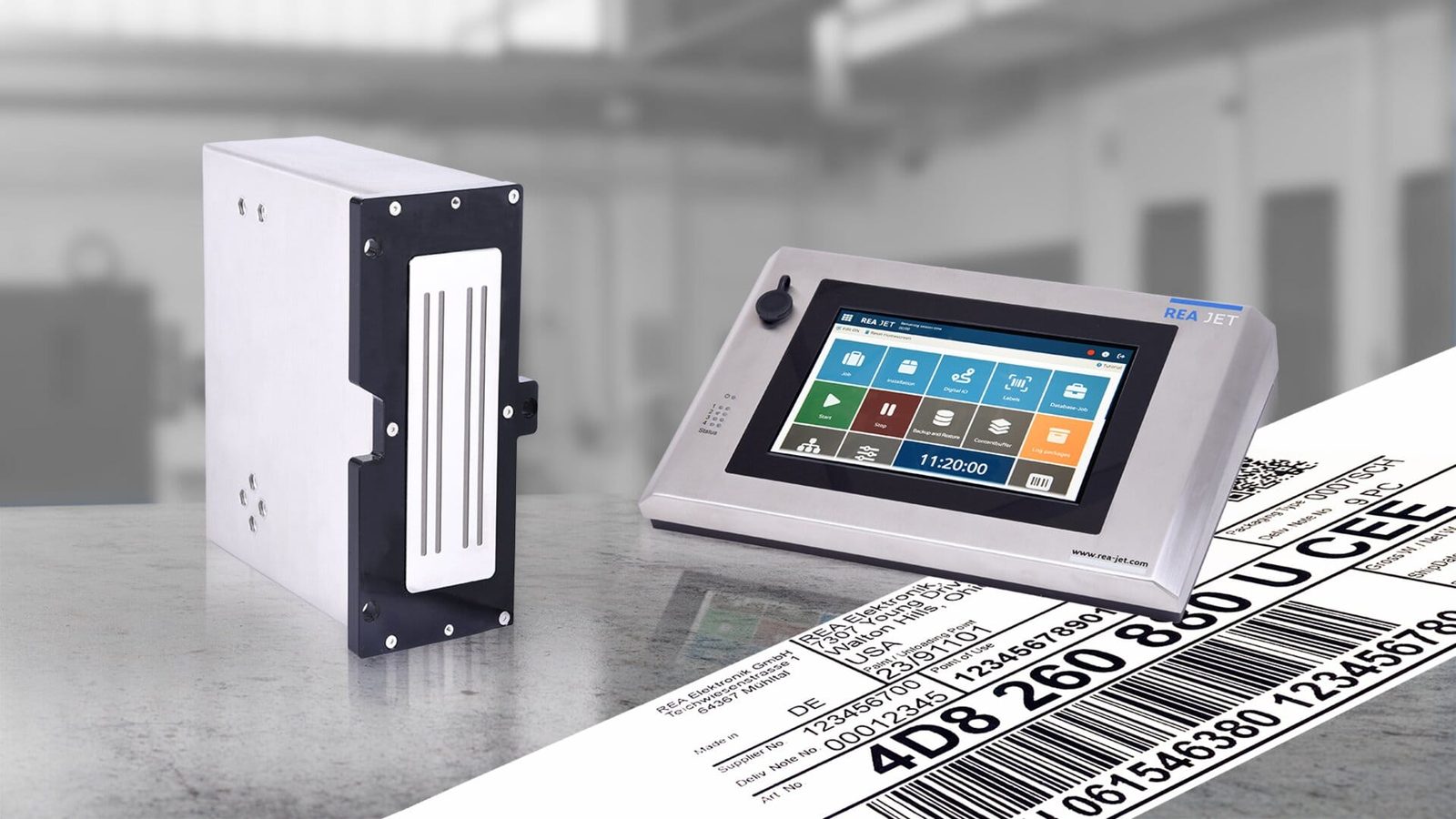
A coder is rarely judged on its purchase price alone. What really matters over several years is what it takes to run: industrial inkjet ink, solvent, filters, cartridges, maintenance and, above all, the time the line runs without interruption. This is what we call total cost of ownership.
Here is a structured way to approach the subject for your inkjet coders, without getting lost in the details. The examples draw on the REA Jet range we distribute and on the information on our product pages.
Total cost of ownership: four components
For an industrial marking printer, total cost of ownership breaks down into four main items:
- Ink: consumption depends on the technology, the density of the message and the volume produced.
- Solvent and fluids: especially present in continuous inkjet, where solvent is an integral part of operation.
- Maintenance: cleaning, and replacement of filters, heads or cartridges, depending on the technology.
- Downtime: a line stoppage caused by a missing consumable, a clogged nozzle or an unsuitable ink often weighs more than the consumable itself.
These items are interdependent. An ink poorly suited to the substrate can multiply rejects; a well-chosen technology reduces both maintenance and stoppages. That is why the initial choice, described in our guide to the inkjet technology to favor, has a lasting effect on the overall bill.
Understanding inks: adhesion, drying, substrate
An ink is chosen based on three main criteria.
Adhesion
On a porous surface such as corrugated cardboard, the ink penetrates the substrate. On plastic, glass or metal, it must instead grip the surface. Inks are therefore formulated for specific families of substrates.
Drying
On a fast line, a slow-drying ink smears on contact with rollers, guides or the next package. According to our data sheets, the range includes fast-drying inks for high-speed lines (large-character) and for moving lines (thermal). For continuous inkjet, drying takes less than a second.
Contrast and product requirements
A pigmented ink provides strong contrast, for example black on brown cardboard. For food packaging, low-migration inks exist in thermal. If your product is destined for a regulated market, validate the ink against your compliance requirements.
The REA Jet inks and supplies page presents inks by technology: water-based, MEK, ethanol or acetone, UV-curable, oil-based or solvent-free. A practical tip: always tell us your substrate, because the same machine does not use the same ink on cardboard and on plastic.
Solvent and cartridges: two different logics
The replenishment method varies significantly from one technology to another, and that is where many planning decisions are made.
- Continuous inkjet: the ink circulates in a closed circuit, and make-up solvent is added automatically to maintain viscosity. You also need to plan for nozzle-flush solvent and filters. The REA Jet SC 2.0 is described as having an ink circuit designed to reduce operating costs.
- Thermal: replenishment is by cartridge. Each cartridge includes a new printhead, which limits maintenance. Cartridge life depends on message complexity, print density and volume.
- Large-character: ink containers, circuit filters and replacement heads, the latter showing a service life up to eight times longer according to the manufacturer.
- Piezo: ink in a container with continuous recirculation to prevent clogged nozzles, as on the REA Jet UP.
Preventive maintenance: the best discreet investment
Regular maintenance is what separates a reliable coder from a temperamental one. Without going into procedures specific to each model, a few principles apply everywhere:
- follow the replacement schedule for filters and wear parts indicated for your model;
- store consumables under the recommended conditions and check their compatibility with the printhead;
- clean heads and sensors at the scheduled frequency, especially in dusty environments;
- log every intervention so you can spot drift before it becomes downtime;
- train operators in simple tasks, such as changing a cartridge or container.
One particular instruction: the ink must always be matched to the printhead materials and the conditions of use. Using an ink that has not been validated for your model exposes you to failures that are hard to diagnose.
Five steps to measure your total cost of ownership
Here is a qualitative method, usable today, to compare your current or future coders.
- Map your coders. List each device, its technology, its substrate and the line it serves.
- Inventory the consumables. For each device, note the ink, solvent, filters and wear parts, as well as the observed replacement frequency.
- Document interruptions. Record the stoppages related to marking: missing consumable, clogging, illegible marking, adjustment. Note their cause and approximate duration.
- Assess rejects and rework. An illegible code leads to rework, returns or refusals downstream. This hidden cost is often the most revealing.
- Compare and prioritize. Rank your devices by the effort they require relative to the value of the line they serve. Target first those that cause the most stoppages or rejects.
This exercise requires no external figures: your own records are enough to reveal where efficiency is being lost.
Signs that a consumable is causing a problem
Before becoming a line stoppage, a consumable problem almost always leaves clues. Learn to recognize them:
- characters that lose sharpness or contrast from one shift to the next;
- longer-than-usual drying, which leaves marks on the next package;
- codes that look fine to the eye but that readers reject more and more often;
- nozzles that need increasingly frequent cleaning;
- ink or solvent consumption that departs from your usual average.
Each of these signals calls for checking ink compatibility, filter condition, ambient conditions and head adjustment before a stoppage occurs.
Planning consumables with a single supplier
When your inks, solvents, cartridges and parts come from a single contact, planning becomes much simpler:
- a single point of contact to validate compatibility between ink, substrate and machine;
- a consolidated view of consumption, useful for anticipating your needs for the next season;
- better consistency if you operate several technologies on different lines, for example in manufacturing or distribution;
- simpler communication with technical teams when a message or an ink needs to change.
If you also operate equipment from another brand, such as Bestcode systems, a joint review of your consumables provides an overall view of your marking needs.
Conclusion: seeing the full expense
Controlling total cost of ownership is not about buying less, but about choosing better, planning better and maintaining better. See the REA Jet inks and supplies page for the options by technology, or browse the full range on our REA Jet page. To validate an ink on your product, we are happy to run a test.
Our team responds within 2 business hours
Permanent stock in Quebec. Fast local supply.