
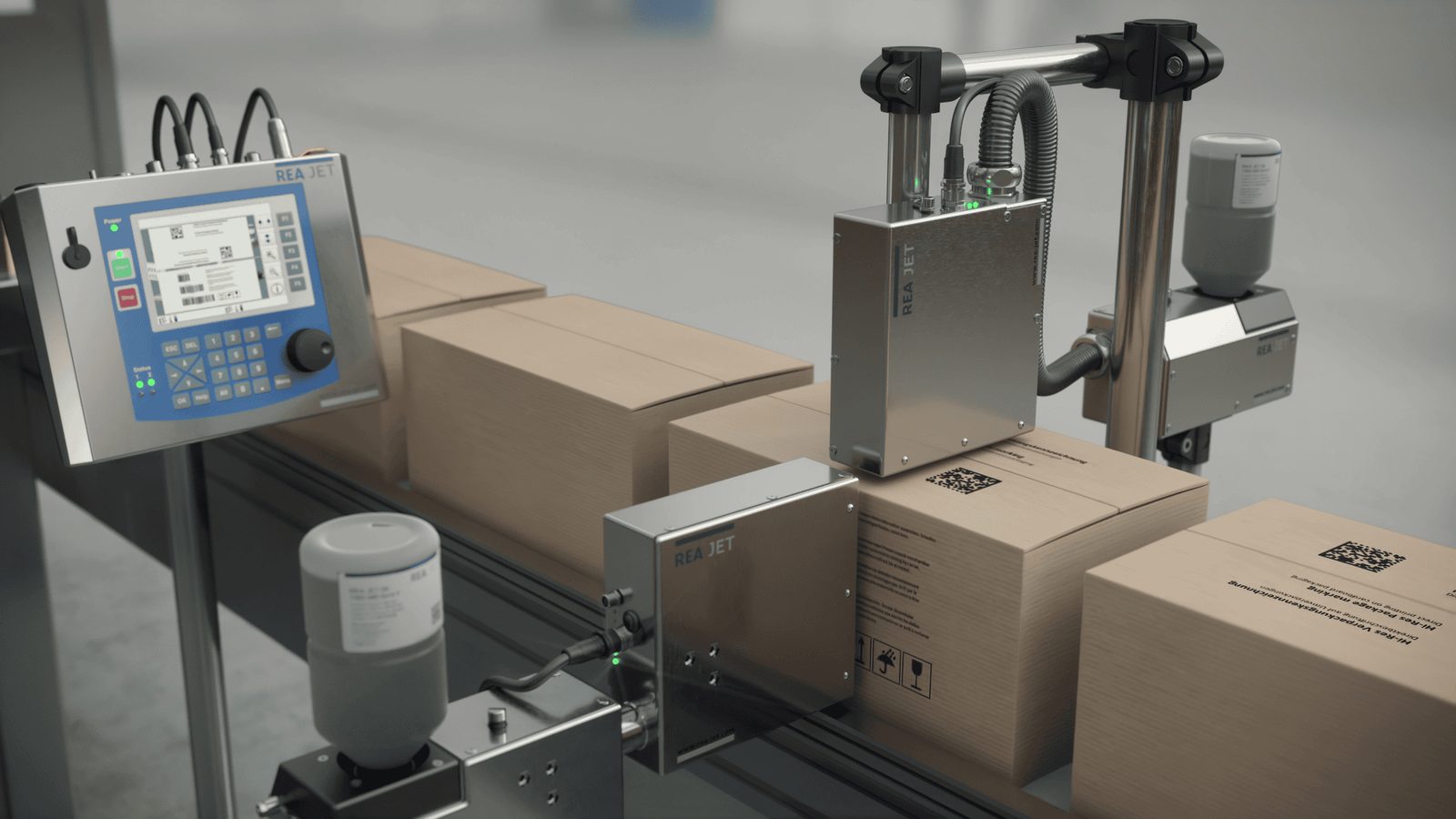
In a warehouse or distribution center, nobody sees the product: they see the case. It is the secondary packaging, the carton and then the pallet, that moves, is stored, scanned and traced. A legible carton marking, with the date, the lot number and the related codes, is therefore what allows the entire supply chain to run smoothly.
Here is how to approach carton and pallet marking with industrial inkjet, based on the REA Jet range we distribute.
Why mark the secondary packaging
Primary packaging (the pouch, the bottle, the jar) carries information intended for the consumer. Secondary packaging carries information intended for the supply chain: who, what, when, which lot. It is used to:
- identify the contents and their production or expiry date;
- link each case to its lot, for reliable food or industrial traceability;
- facilitate receiving, storage and order picking through reader-friendly codes;
- support a targeted recall: quickly locate the affected cases rather than freezing an entire inventory.
In other words, good case marking is a discreet but valuable insurance policy.
Corrugated cardboard: a porous substrate to understand
Corrugated cardboard is the substrate of choice for shipping cases. Its surface is absorbent: the ink bonds by penetrating the fiber, which promotes adhesion but calls for an ink that limits spreading and bleeding so that codes stay sharp.
According to the REA Jet inks and supplies page, the technologies for corrugated cardboard come with water-based inks for standard cardboard, fast-drying inks for high-speed lines, pigmented inks for strong contrast (black on brown cardboard) and high-viscosity inks to limit bleeding. Coated, waxed or laminated cardboard behaves differently from raw cardboard: the ink must then be validated on the actual substrate.
Pallets: direct marking and thermal labels, two complementary tools
To identify a pallet, people instinctively think of the label. It remains a tool of choice: a thermal label makes it possible to print a standardized pallet barcode with all the logistics information, and to apply it where needed.
Direct inkjet marking plays a complementary role. It is well suited to information that must appear directly on the packaging or the wood: lot number, designation, visual marker. The two approaches often coexist: inkjet marks the case at manufacturing, while the pallet label identifies the consolidated load at shipping.
For large visual markers or on wooden pallets, spray marking from the Spray Mark family is also an option. The REA Jet STC lists pallet marking among its uses.
Technologies suited to cartons and pallets
Large-character: legibility at a distance
The REA Jet DOD 1.0 and the REA Jet DOD 2.0 print text, data and logos up to 140 mm per printhead, on absorbent and non-absorbent surfaces. This format is well suited to cases that must be read from a good distance: contents, lot, destination or logo.
High resolution: barcodes and 2D
When the case must carry a barcode or a dense 2D code, high resolution becomes valuable. The REA Jet HR 2.0 prints sharp, legible codes up to 600 dpi and is listed by the manufacturer among the solutions for secondary packaging, dates, lot codes and GS1-compliant barcodes. It suits coated cartons, films and labels.
For corrugated cardboard and porous materials such as wood, the REA Jet GK 2.0 provides direct, high-contrast marking, with variable print height up to 100 mm, 1,200 dpi and a maximum speed of 200 m/min. It is presented as an alternative to labels and preprinted cartons.
Conveyor integration
An excellent coder in the wrong place gives poor marking. Before installation, review the following:
- Head position. The distance between the head and the carton must stay constant: stable case guiding is essential.
- Triggering. A photoelectric sensor that detects the case at the right moment ensures consistent message placement.
- Conveyor speed. It must match the capacity of the chosen technology and be stable during printing.
- Marking area. Choose a flat, clean, clear face, away from adhesive tape and creases.
- Environment. Cardboard dust, moisture and vibration must be taken into account when choosing the enclosure and mounting.
The modular mounting of REA Jet models and their REA TITAN control platform make it easier to integrate with the existing line, including positioning several heads to mark more than one face.
What information should go on the case?
A well-marked case carries just what is needed, clearly visible. Here is the order of priority we generally recommend discussing with your warehouse and quality teams:
- The lot and date, in characters large enough to be read quickly during a visual check;
- A barcode or 2D code containing the product identifier and, if needed, the lot, to automate receiving;
- The product designation or internal reference;
- A logo or brand mention, if visual identification matters to your customers.
Before finalizing the layout, print a sample and have it read by the same readers used at receiving by your customers. This is the best way to ensure the message meets both internal needs and those of downstream partners.
Common mistakes
- Choosing the ink without testing the carton. Two cartons that look alike can absorb very differently.
- Printing on an uneven area. A head that marks over a crease or tape produces a distorted code.
- Neglecting contrast. A code that is legible to the eye is not always legible to a reader.
- Forgetting continuous verification. A periodic check at the end of the line avoids discovering a problem on arrival at the customer.
- Printing too small. On a case, favor legibility at a distance rather than copying the format of primary packaging.
Examples by sector
- Food: legible date and lot on every case to support traceability. See our food solutions.
- Distribution and logistics: receiving and shipping codes on mixed cases. See our distribution page.
- Manufacturing: part designation, references and lots on industrial cartons, as presented on our manufacturing page.
For materials rougher or harder than cardboard (wood, steel, construction panels), the adhesion issues are different. We cover them in our article on marking steel, wood and construction materials.
Move to flawless case marking
Describe your carton, your throughput and the information to be marked. We will recommend the most relevant technology and run a test on your packaging.
Our team responds within 2 business hours
Permanent stock in Quebec. Fast local supply.