
Marking a carton is one thing. Marking a steel beam, a board of dimensional lumber or a sheet of drywall is another. In industrial marking, the substrate dictates almost everything: the technology, the ink, the surface preparation and the durability you can expect. Here is how to approach these demanding surfaces, based on the REA Jet solutions we distribute.
Difficult substrates, for good reasons
Steel, wood and construction materials have one thing in common: they lack the consistency of packaging. Surfaces can be oily, rough, dusty, damp, hot, textured or uneven; the list of challenges is long. Yet the information to be marked is often essential: material designation, lot number, dimensions, 2D code, logo or quality mark.
The marking has to survive handling, outdoor storage and, at times, heat or heat treatment. It is the combination of technology and ink that decides the outcome.
Steel and metal: preparation and durable inks
For metal marking, adhesion depends on three elements: the condition of the surface, the type of ink, and the process the part undergoes after marking.
Preparing the surface
A film of rolling oil, light rust or grinding dust compromises adhesion. Depending on the condition of your parts, cleaning or degreasing, or choosing an ink formulated for oily surfaces, makes all the difference. A test on a representative part is worth more than an assumption.
Inks designed for steel and aluminum
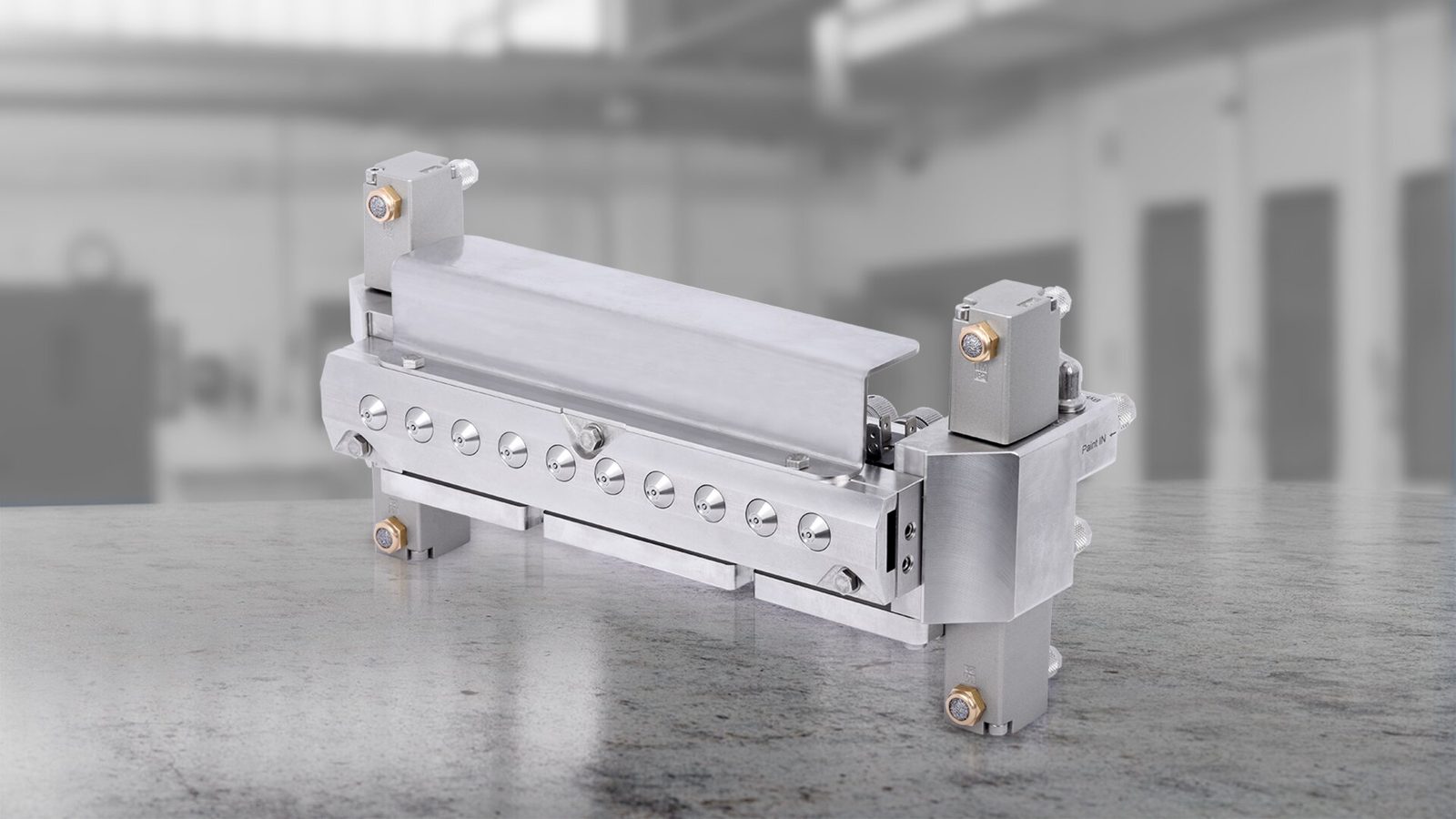
In the steel and aluminum industry, annealing-resistant inks and hot-marking inks are essential. This is precisely one of the purposes of the REA Jet ST system (Spray Mark SRE-10 block): automatically producing large lettering to replace stencils and markers, with highly legible marks up to 206 mm in height. It is used to apply material designations, lot numbers, 2D codes and logos, and can apply paints and varnishes that remain legible from a distance.
If your need is limited to quality marks (dots, lines, color codes) on metal or tubing, the STC and STF systems from the same family cover other production scales, with up to four simultaneous colors for the STF.
Wood: a living surface
Wood marking has to contend with a porous material that is sometimes damp and whose texture varies from piece to piece. That porosity is an asset for adhesion, provided you choose an ink that holds its contrast without bleeding into the grain.
Two families of solutions stand out:
- large-character (DOD 1.0 and DOD 2.0) for designations, lots, logos and large text on wood and dimensional lumber;
- high-resolution piezo, with the REA Jet GK 2.0, presented for direct, high-contrast marking on cardboard, wood and textiles, with up to 100 mm in height and 1,200 dpi, or the REA Jet UP for versatile direct printing, with up to 1,500 dpi horizontally.
For pallets and large visual markings, spray marking is also an option worth considering.
Construction materials: concrete, drywall, insulation
Construction materials raise texture and dust challenges. Drywall boards and insulation are absorbent surfaces that respond well to large-character systems. For concrete and masonry, the Spray Mark family is among the surfaces listed on our inks and supplies pages, with oil-based or solvent-based inks and paints for rough surfaces.
The DOD 1.0 lists construction materials, cases and cartons, polystyrene and insulation, and pallets and wood among its uses. The ST cites panels and construction materials. Plants that produce panels, profiles or pipes will recognize these applications; see also our manufacturing page.
Which technology for which substrate
| Substrate | Technologies to consider | Point to watch |
|---|---|---|
| Steel and aluminum | Spray Mark (ST, STC, STF) | Annealing-resistant or hot-marking inks; surface condition |
| Wood and dimensional lumber | Large-character (DOD), piezo (GK 2.0, UP) | Contrast, bleeding into the grain, moisture |
| Drywall and insulation | Large-character (DOD) | Absorbent surface, dust |
| Concrete and masonry | Spray Mark | Roughness, suitable paints |
This table is a starting point, not a verdict. Non-porous or coated surfaces call for specialized inks: tell us about your substrate, and the final choice will be made based on a test.
Test adhesion before rolling out
Markings that fail usually do so because adhesion was not validated under real conditions. Here is a simple approach:
- Gather representative samples: several lots, several surface conditions, including borderline cases.
- Print with the intended ink, at the distance and speed planned for the line.
- Let it dry for the actual transit time on the line; paint takes longer to dry than inkjet ink.
- Stress-test the marking: rubbing, moisture, handling, storage and, where applicable, heat treatment or outdoor exposure.
- Document the result and decide on the technology, the ink and the surface preparation.
Inks are listed on the REA Jet inks and supplies page. If you already use products from other suppliers, such as EBS or Bestcode, the same test protocol applies.
Durability: what the marking must withstand
The durability of a marking is defined by the part's journey, not by the production line alone. Ask yourself these questions:
- Will the part be stored outdoors, exposed to moisture, sun or frost?
- Will it undergo heat treatment, annealing or another process that requires a resistant ink?
- Must the marking remain legible until final installation, or only until delivery?
- How much rubbing or handling will the surface endure?
The answers determine the type of ink, the drying time required and, sometimes, the technology itself.
What information should you mark?
Product marking on a construction or industrial material generally includes:
- the material or alloy designation;
- the lot or heat number, essential for traceability;
- the dimensions, grade or standard applicable to your product;
- a 2D code or barcode for automated reading;
- a logo or brand identification.
The richer the information, the more important it is to choose a technology that reproduces it sharply. If your product ends up in a case or on a pallet, also read our article on marking cartons and pallets.
Send us your samples
The most reliable way to settle on a choice is to see the marking on your own material. Send us your samples and describe your line, and we will produce a marked sample to validate the choice of technology and ink.
Our team responds within 2 business hours
Permanent stock in Quebec. Fast local supply.