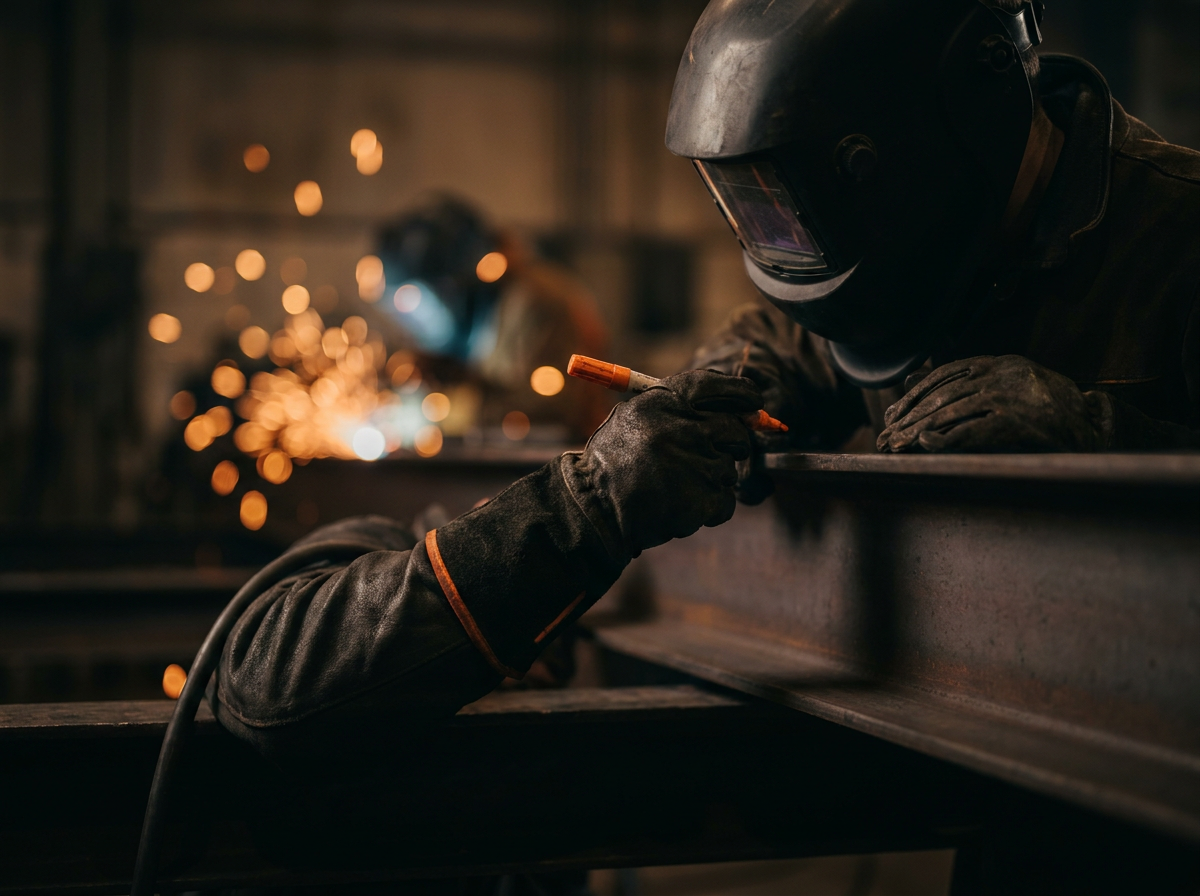
For a welder or a steel erector, marking is part of the trade: cut marks, part numbers, assembly direction, points to rework. Yet the surface is rarely ideal. Mill scale, oil, grinding dust, raw metal or still-hot metal: each condition changes the result.
The welder's pencil and the industrial paint marker are two different answers to this challenge. Here is how to tell them apart, with the models in the U-Mark range distributed by ThermoLabels.ca.
Two Tools, Two Logics
The welder's pencil, traditionally, is a marking stick designed to draw on raw, often hot metal, in the demanding environment of welding. The paint marker lays down an opaque coat, visible from afar and easy to spot on a dark part.
Neither is better in the absolute. It all depends on what you are marking, at what stage of the process and for how long the mark must remain visible.
Questions to Ask Before Choosing
- At what stage are you marking? Before welding, during fabrication or at final inspection.
- What is the condition of the surface? Raw, oily, rusty, ground.
- Is the part hot at the time of marking? If so, validation with our team is essential, because we do not communicate temperature limits without confirmation.
- Must the mark be permanent or temporary?
When the Paint Marker Takes Over
For raw steel and difficult surfaces, several U-Mark models are relevant. The 100P Industrial is designed for oily metal, rusty metal and concrete, with an opaque and durable mark. Its 100P Fine Line version suits precise inscriptions, such as a weld or part number.
The A30 Broad, with its broad Megaflow tip, makes the difference on rusty metal and rough surfaces. The A4 Fine Tip is for precise marks on metal. As for the oil-based 130P reversible, it lets you go from a fine to a broad line without changing tools.
The Case of Hot Metal
This is the question that comes up most: which marker for a part that is still hot? We prefer to be clear: the data sheets we have do not allow us to promise behavior at a given temperature. If your process involves hot metal, tell us about your application before buying. We validate the appropriate model with you, rather than leaving you to test at your own expense.
Welding and Metallurgy: Different Needs
In Welding and Fabrication
You look for quick, legible marks under the light of a sometimes poorly lit shop. An opaque paint and a tip suited to the desired line are your best allies. A fine line for precision marks, a broad line for sorting or status marks.
In Metallurgy and Steel Storage
Here, identification follows the part through several stages: receiving, storage, machining, shipping. Resistance to oil, rust and handling matters more than line fineness. Models for oily and rusty surfaces should be considered first.
A Simple Method to Validate
- Choose two or three candidates based on your surface.
- Test them on a representative part, in your real conditions.
- Assess legibility after handling and after the next process step.
- Standardize the chosen model and store it at every station.
This approach takes a day, and it saves months of illegible marks or needless scrap.
Safety and Good Practices
Always follow your manufacturer's and employer's health and safety instructions. For enclosed spaces, the water-based, low-VOC W20 is a lead to explore, to be validated for your surface. And in every case, proper protective equipment remains a must.
Next Step: A Quote or Samples
Do you weld, fabricate or handle steel and want the right marker for each station? Request a quote or samples: our team validates the model, the surface and the conditions of use with you before you order. Browse the complete U-Mark marker range, then write to us.
Our team will help you build a simple selection of two to four models from our industrial markers page.
Do you also identify your products, cartons or pallets? Explore our thermal labels, ARMOR-IIMAK ribbons and Zebra printers, or keep reading on the ThermoLabels blog.
Our team responds within 2 business hours
Permanent stock in Quebec. Fast local supply.